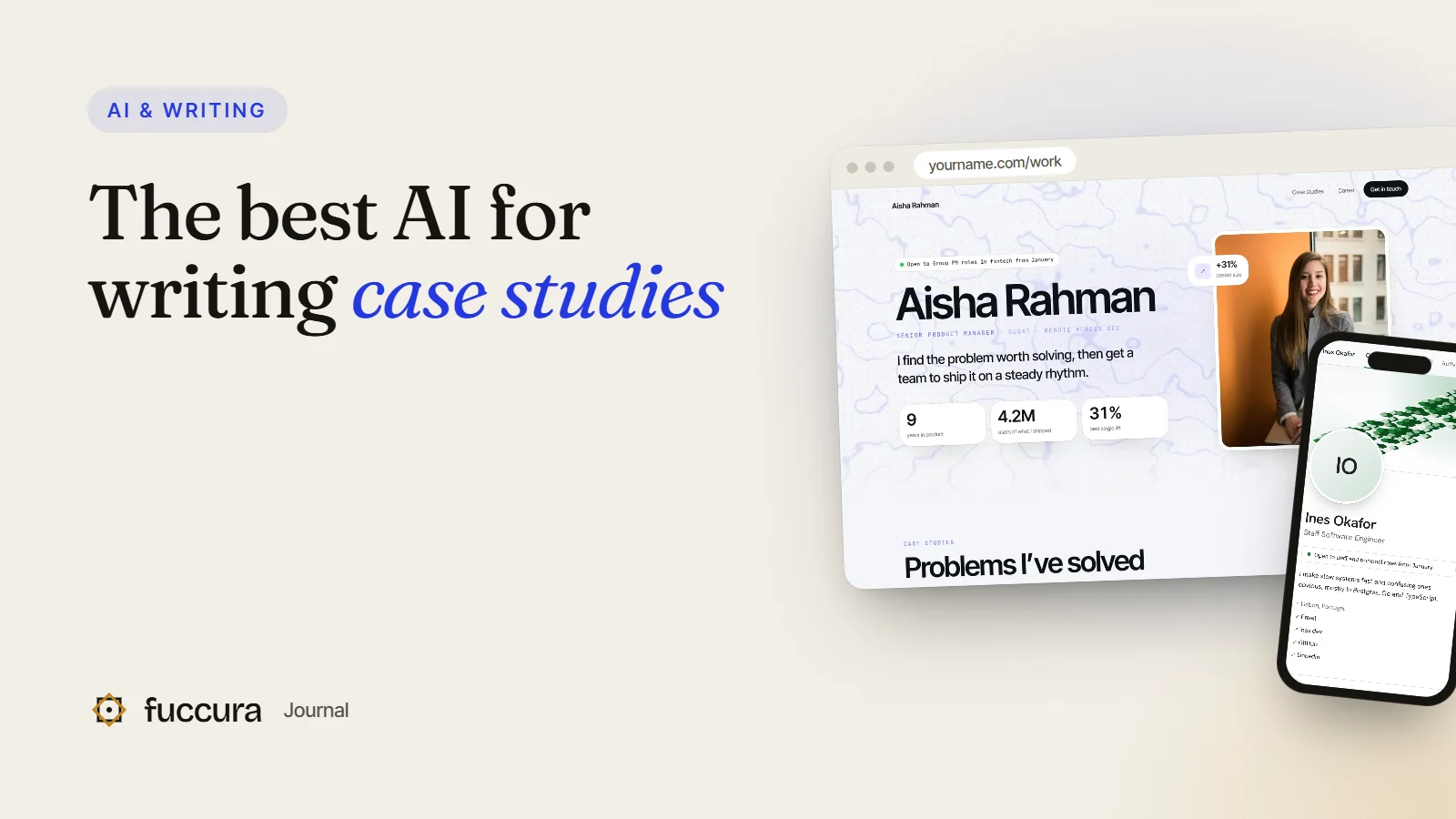
The best AI for writing case studies is the one that helps you organise real project evidence without inventing results, responsibilities, or credentials. For most professionals, a general-purpose writing assistant is useful for outlining, questioning, editing, and adapting a draft, while the final facts must come from your own notes and records.
A case study is not a fictional success story. It is a structured explanation of a real piece of work: the situation, your role, the decisions you made, the work delivered, and the outcome you can honestly support. The right AI tool should make that evidence clearer, not make the claims bigger.
Best AI for Writing Case Studies: What Should You Choose?
The best AI for writing case studies is a dependable general-purpose assistant used as an editor and thinking partner, not as a source of project facts. ChatGPT, Claude, and Google Gemini can all help turn structured notes into a readable first draft, but no tool can verify your private project history for you.
Buying intent often starts with a product question, but the more important question is workflow fit. A useful tool should accept your notes, follow a defined structure, preserve uncertainty, and let you review every sentence before publication.
ChatGPT can help with outlines, interview-style questions, rewriting, and audience-specific versions. Claude is commonly used for handling longer documents and careful editing. Google Gemini can be convenient for people who already work in Google’s productivity environment. These are broad capabilities, not a guarantee that any tool will produce an accurate case study without supervision.
Choose based on the work you need to do. If you have scattered notes, prioritise structure and questioning. If you have a complete draft, prioritise editing and clarity. If you need to publish several versions, prioritise reusable prompts, consistent terminology, and a review process.
What Makes an AI Case Study Tool Worth Using?
A worthwhile AI case study tool preserves source truth, improves structure, and gives you control over the final text. The most important features are evidence handling, editable output, predictable formatting, and a clear boundary between your facts and the tool’s suggestions.
Evidence preservation
Evidence preservation means keeping claims tied to information you supplied. Ask the AI to mark missing details instead of filling them in, especially for metrics, client names, dates, budgets, job titles, awards, and technical specifications.
A strong instruction is: “Use only the facts in these notes. If a detail is missing, write [需要 evidence] or ask a question. Do not infer a percentage, timeline, client name, or business result.” This reduces the risk of polished but unsupported claims.
Useful questioning
Good case study writing depends on details that people often omit because they know the project too well. An AI assistant can ask about the starting problem, constraints, alternatives considered, your decisions, collaboration, testing, revisions, and the outcome.
Questions are more useful than generic praise. “What changed after launch?” is better than “Describe your success.” If you do not know the answer, say so. A credible case study can explain what was delivered without pretending to know an unmeasured business impact.
Control over language
Look for an assistant that can change tone, length, reading level, and format without changing the underlying facts. A portfolio case study may need a concise summary, a detailed project page, and a short introduction for a CV or proposal.
Ask the tool to preserve technical names, remove repetition, and distinguish your contribution from the team’s contribution. “I designed” and “the team delivered” do not mean the same thing, and a strong portfolio keeps that distinction visible.
AI Case Study Tools Compared by Use Case
No single AI product is automatically best for every case study. Compare tools by the job they perform in your workflow: drafting, long-document editing, workspace integration, or publishing preparation.
| Tool or approach | Useful for | Check before publishing | | ChatGPT | Outlines, questions, rewrites, summaries, and multiple draft versions | Whether every result, metric, and responsibility came from your notes | | Claude | Longer source material, detailed editing, and structured feedback | Whether the final draft preserves your terminology and project boundaries | | Google Gemini | Drafting and editing within workflows built around Google tools | Which source documents are included and whether confidential material is appropriate to share | | Template plus manual review | Repeatable case studies with consistent sections and a personal voice | Whether the template leaves room for project-specific evidence | | Portfolio publishing platform | Presenting the finished case study with your work and professional profile | Layout, ownership, editing control, and whether unsupported claims remain |
The table describes practical use cases rather than rankings. Product features, limits, data controls, and availability can change, so review the current terms and settings before sending sensitive project material to any external AI service.
Fuccura is not presented as an AI case study writer. Fuccura is a portfolio builder that can help you publish selected work after you have written and reviewed it. You can import information from a CV, GitHub, or LinkedIn data export, then create a portfolio on a free Fuccura address or connect a domain registered in your name.
How to Use AI Without Inventing Portfolio Claims
Use AI in four controlled stages: gather facts, create a structure, edit for clarity, and verify every claim. Separating these stages makes it easier to identify where a sentence came from and prevents fluent wording from being mistaken for evidence.
1. Gather the source material
Start with project notes, briefs, specifications, screenshots, published work, meeting notes, and your own recollection. Separate confirmed facts from impressions, confidential information, and details that require permission before publication.
Create a simple evidence list with labels such as “confirmed,” “needs checking,” and “do not publish.” Include your role, the project context, the work completed, tools used, constraints, decisions, and outcomes. If a number is not recorded, do not create one.
2. Build the case study structure
Ask the AI to arrange your evidence under clear headings: overview, challenge, role, approach, key decisions, implementation, result, and reflection. A structure helps readers understand the work before they evaluate the visual presentation.
Keep each section focused on one idea. A short paragraph about the constraint is easier to trust than a long paragraph that mixes the brief, your process, team activity, and final result.
3. Add the human decisions
AI can identify repeated phrases, but it cannot replace your professional judgement. Explain why you chose one approach over another, what trade-off you accepted, and what you would do differently with more time or information.
For a designer, that might mean explaining a hierarchy or accessibility decision. For a developer, it might mean describing an implementation constraint or testing choice. For a consultant, it might mean showing how the recommendation responded to the client’s stated problem without revealing confidential information.
4. Verify the final draft
Read the draft against the source material line by line. Check names, dates, technologies, ownership, sequence, measurements, and the difference between your contribution and the wider team’s work.
Remove invented specificity. “Reduced support requests by 28%” requires a real source. If you cannot support that statement, replace it with a precise description of what changed, such as “The revised guidance gave users a single place to find the setup steps.”
For a useful model of the structure, review this portfolio project case study guide before you prompt an AI assistant. A clear source structure usually produces a better draft than a vague request for “a compelling case study.”
Prompts That Produce More Reliable Case Studies
The best case study prompts define the source, audience, structure, tone, and boundaries. Tell the AI what it may use, what it must not infer, and how it should flag missing information.
Use a prompt such as: “You are an editorial assistant. Use only the project notes below. Draft a case study with the headings Context, Challenge, Role, Approach, Decisions, Outcome, and Reflection. Keep first-person claims limited to my documented work. Do not invent metrics, clients, dates, tools, awards, or business results. Put [missing detail] wherever evidence is absent.”
For an editing pass, use: “Edit this draft for clarity and repetition. Preserve every factual claim, technical term, qualification, and uncertainty. Do not make the result sound larger than the evidence supports. List any sentence that needs source verification after the edited version.”
For a shorter portfolio summary, use: “Condense this verified case study to 80 words. Keep the project type, my role, the main decision, and the documented outcome. Do not add a metric or adjective that is not present in the source.”
Prompts should not ask an AI system to “make this sound impressive” without limits. That instruction often rewards confidence rather than accuracy. Replace it with a specific editorial goal: clearer sequence, fewer repeated words, stronger explanation of decisions, or a more accessible definition of technical terms.
Save prompts that work, but do not treat them as a substitute for review. A reusable prompt can improve consistency across several case studies while still producing errors if the source notes are incomplete.
How to Turn the Draft Into a Portfolio Asset
A case study becomes more useful when the writing, evidence, and page design support one another. Publish the project with a clear title, short summary, role, tools where relevant, selected visuals, and a readable explanation of the work.
Readers usually scan before they commit to the full page. Put the project type and your contribution near the top, then make the detailed reasoning easy to find. Avoid burying the most important fact under a long introduction about your general career.
Use visuals only when they clarify the work and when you have permission to show them. Crop interfaces carefully, remove private information, and label unfinished concepts honestly. A polished image cannot repair an unclear or unsupported description.
Fuccura’s templates are set by a designer and intended to preserve the layout while content is edited. That matters when a case study contains headings, paragraphs, links, and selected project material that should remain readable as the page changes.
You can connect a domain registered in your name or publish to a free Fuccura address. Owning the domain and keeping control of the content can make your professional identity less dependent on a single social profile or job platform.
If your portfolio needs more than project pages, Fuccura’s Basic plan is free to start and includes one portfolio with a blog. The site also describes plans and tools that may change, so check the current offering before choosing a setup.
Before publishing, review the case study page checklist and confirm that every link, image, claim, and contact path works. Do not publish confidential client information, private repository details, or invented achievements simply because an AI draft makes them sound plausible.
Is AI Writing Right for Your Case Study Workflow?
AI writing is useful when the difficult part is organising, questioning, or editing real information. It is a poor substitute for project memory, evidence, judgement, permission, or a clear account of what you personally did.
Use an AI assistant when you have source material and want a faster route to a reviewable draft. Write more of the first version yourself when the project depends on personal reflection, sensitive context, or a distinctive voice that generic language could flatten.
For a job seeker, the workflow can begin with a CV and selected project notes. For a developer, it can begin with a GitHub repository and a written explanation of the problem and implementation. For a photographer, researcher, lawyer, doctor, teacher, or tradesperson, the source material and privacy requirements will differ, but the rule remains the same: publish only what you can stand behind.
Fuccura can help you move from existing career information to a portfolio with selected work, a blog, and a domain under your control. Start building your portfolio, or request a quotation for agent support if you need help with an agent workflow.
For another practical reference, read the portfolio case study example and compare its structure with your own evidence. The goal is not to sound like an AI. The goal is to make real work easier for the right reader to understand.
When you are ready to publish, use a clear project case study format, review the final page yourself, and remove anything that cannot be verified.
Frequently asked questions
What is the best AI for writing case studies?
A general-purpose assistant such as ChatGPT, Claude, or Google Gemini can be effective for outlining, questioning, and editing. The best choice depends on your documents, workflow, and review needs; accuracy still depends on the evidence you provide and verify.
Can AI write a case study from my CV?
AI can use a CV to create a basic structure and identify possible project topics, but a CV usually lacks the context and decisions that make a case study credible. Add project notes, your specific role, documented outcomes, and any restrictions on what may be published.
How do I stop AI from inventing case study results?
Tell the AI to use only supplied facts, mark missing information, and never infer metrics, dates, clients, or achievements. Then compare the final draft with your source material line by line before publishing.
Should I use AI for a portfolio case study?
Yes, if you use it for organisation, questions, editing, and alternate versions rather than as a replacement for your own account of the work. Keep the final case study grounded in real responsibilities, decisions, evidence, and permissions.
Where should I publish AI-assisted case studies?
Publish them on a professional portfolio that gives you control over the content, layout, and web address. Review the page for accuracy, readability, confidentiality, and ownership before sharing it with employers, clients, or collaborators.
Last updated: 14 October 2026